You know that feeling when you think you’ve got a simple case of food poisoning, but it turns out to be something way more complicated? That’s kind of what happens when typhoid fever decides it’s not satisfied with just making you miserable and decides to go after your bones, too.
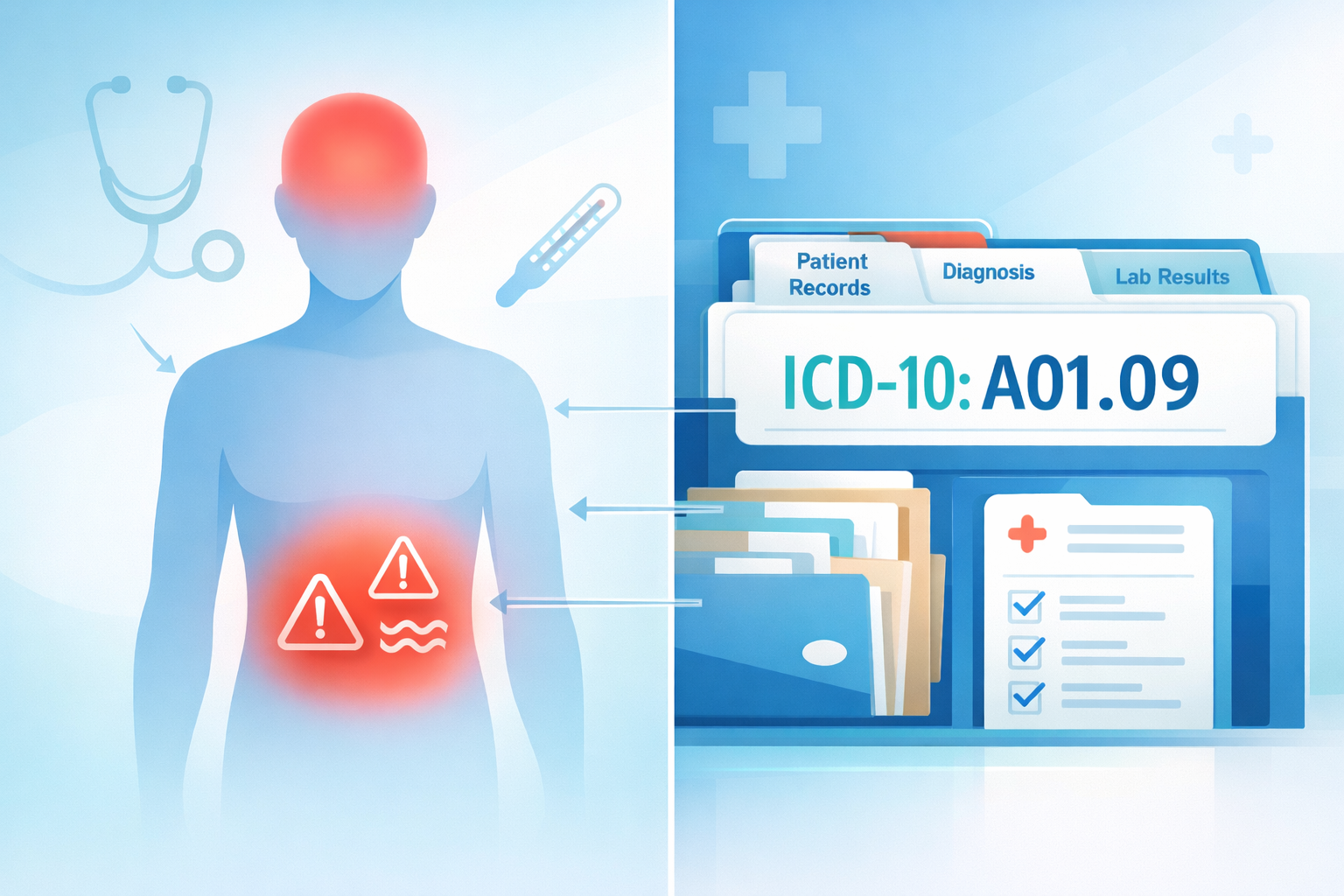
Today, we’re diving into ICD-10 code A0105, which is the medical billing code for typhoid osteomyelitis. Don’t let the fancy terminology scare you off. I’m going to break this down like we’re chatting over coffee.
What Exactly Is A0105?
Think of ICD-10 codes as the universal language that doctors, hospitals, and insurance companies use to communicate. Code A0105 specifically identifies a situation where typhoid fever (caused by the bacteria Salmonella typhi) has spread to the bones, causing osteomyelitis, which is just a medical way of saying “bone infection.”
This code falls under the broader A01 category for typhoid and paratyphoid fevers, sitting alongside other complications like typhoid meningitis and typhoid pneumonia.
Why Should Medical Billers Care?
Here’s the thing: accuracy in medical coding is like building a house. If your foundation (the diagnosis code) isn’t right, everything else crumbles. Using A0105 correctly ensures:
- Proper reimbursement from insurance companies
- Accurate patient records for future reference
- Better tracking of disease patterns and complications
- Reduced claim denials that create headaches for everyone
Getting this code wrong is like sending a package to the wrong address. It’ll come back to you, and you’ll have to do the whole thing over again.
What Does Typhoid Osteomyelitis Actually Look Like?
Imagine typhoid fever as an unwelcome houseguest who’s already overstayed their welcome. Now picture that guest deciding to redecorate your bones without permission. That’s essentially what’s happening here.
Patients with typhoid osteomyelitis typically experience:
- Persistent bone pain that feels like a deep, constant ache
- Swelling and tenderness over the affected bone
- Fever that just won’t quit
- Limited movement in nearby joints
- General fatigue and weakness
The bones most commonly affected are the spine (vertebrae), ribs, and long bones like the femur. It’s like the bacteria has a preference for the structural beams of your body’s framework.
The Clinical Picture
Typhoid osteomyelitis is relatively rare, thank goodness. It usually shows up in people who either didn’t get treated for typhoid fever early enough or whose immune systems are already compromised. The bacteria essentially hitchhike through the bloodstream and set up camp in the bone tissue.
Diagnosing this condition requires detective work: blood cultures, bone scans, MRI imaging, and sometimes even bone biopsies. It’s not something you can eyeball and guess at.
Coding Guidelines for A0105
When you’re coding for typhoid osteomyelitis, remember these key points:
Specificity matters. The code A0105 already tells us it’s typhoid-related osteomyelitis. You don’t need to add a separate code for general osteomyelitis on top of it.
Document the site. While A0105 covers the diagnosis, you’ll want clinical documentation specifying which bone is affected. This helps paint the complete picture for medical necessity.
Look for complications. Patients with bone infections often have other issues going on. Check if there are additional diagnoses that need coding, like sepsis or pathological fractures.
Verify treatment history. Documentation should reflect whether this is an initial encounter, a subsequent encounter, or a sequela. The seventh character extension will matter for certain reporting scenarios.
Real-World Billing Scenarios
Let’s say a patient comes in with chronic back pain. After extensive workup, including blood cultures and MRI, they’re diagnosed with vertebral osteomyelitis secondary to typhoid fever. You’d use code A0105 as your primary diagnosis.
Or picture this: someone who traveled internationally returns with typhoid fever symptoms. They receive treatment, but weeks later develop hip pain. Further investigation reveals osteomyelitis. Again, A0105 is your go-to code.
Treatment and Prognosis
Treatment typically involves long-term antibiotic therapy (we’re talking weeks to months, not days), sometimes requiring IV administration initially. In severe cases, surgical intervention might be necessary to remove dead bone tissue or drain abscesses.
The good news? With proper treatment, most patients recover fully. The bad news? It’s a long haul, like running a marathon instead of a sprint.
Why This Code Matters Beyond Billing
Understanding codes like A0105 helps us track global health patterns. Typhoid fever is rare in developed countries but remains a significant problem in areas with poor sanitation. When we code accurately, we contribute to epidemiological data that helps public health officials allocate resources and develop prevention strategies.
It’s bigger than just getting paid. It’s about being part of the healthcare ecosystem that protects communities.
Common Documentation Pitfalls
Medical coders often run into issues when:
- Documentation doesn’t clearly link the osteomyelitis to typhoid fever
- The typhoid diagnosis is buried in the history without confirming active infection
- Sites of bone involvement aren’t specified
- Culture results aren’t clearly documented
Think of documentation as breadcrumbs leading you to the right code. If the trail is unclear, you can’t confidently assign A0105.
Tips for Clean Claims
Want to avoid denials? Here’s your checklist:
Make sure the medical record clearly states “typhoid osteomyelitis” or “osteomyelitis due to Salmonella typhi.” Vague language creates coding confusion.
Verify that diagnostic testing supports the diagnosis. Insurance reviewers want to see proof, not hunches.
Check that the treatment plan matches the diagnosis severity. Aggressive antibiotic therapy for months makes sense for bone infections; a three-day course doesn’t.
Confirm that the provider documentation includes the clinical reasoning. Why do they believe this is typhoid-related rather than another cause of osteomyelitis?
The Bottom Line
ICD-10 code A0105 might seem like just another alphanumeric combination in the massive coding manual, but it represents real patients dealing with a serious complication of an already miserable disease. Getting this code right means those patients get appropriate treatment coverage, facilities get proper reimbursement, and the healthcare system gains valuable data.
Medical coding isn’t just paperwork. It’s the bridge connecting clinical care to the business of healthcare. And when you understand the story behind codes like A0105, you’re not just pushing papers. You’re ensuring that someone’s painful bone infection gets the recognition and treatment it deserves.
So next time you see A0105 pop up in a chart, you’ll know you’re looking at a case that needs careful attention, thorough documentation, and precise coding. Because in our world, those five characters tell a story of bacteria gone rogue, bones under siege, and a healthcare system working to make things right.
Stay curious, keep learning, and remember that every code represents a human being hoping to feel better soon.
Have questions about typhoid osteomyelitis coding or other complex ICD-10 scenarios? Drop them in the comments below. We’re all learning together in this ever-evolving world of medical billing.