When you’re knee-deep in medical billing codes (pun intended), you’ll occasionally stumble upon codes that make you do a double-take. ICD-10 code A01.04 is one of those rare birds that deserves some attention, especially if you’re working in regions where typhoid fever still poses a health threat.
What Exactly is A01.04?
Let’s break it down in plain English. A01.04 is the official ICD-10 code for Typhoid Arthritis, which falls under the broader category of intestinal infectious diseases. Think of it as the unwanted houseguest who shows up after typhoid fever has already crashed the party.
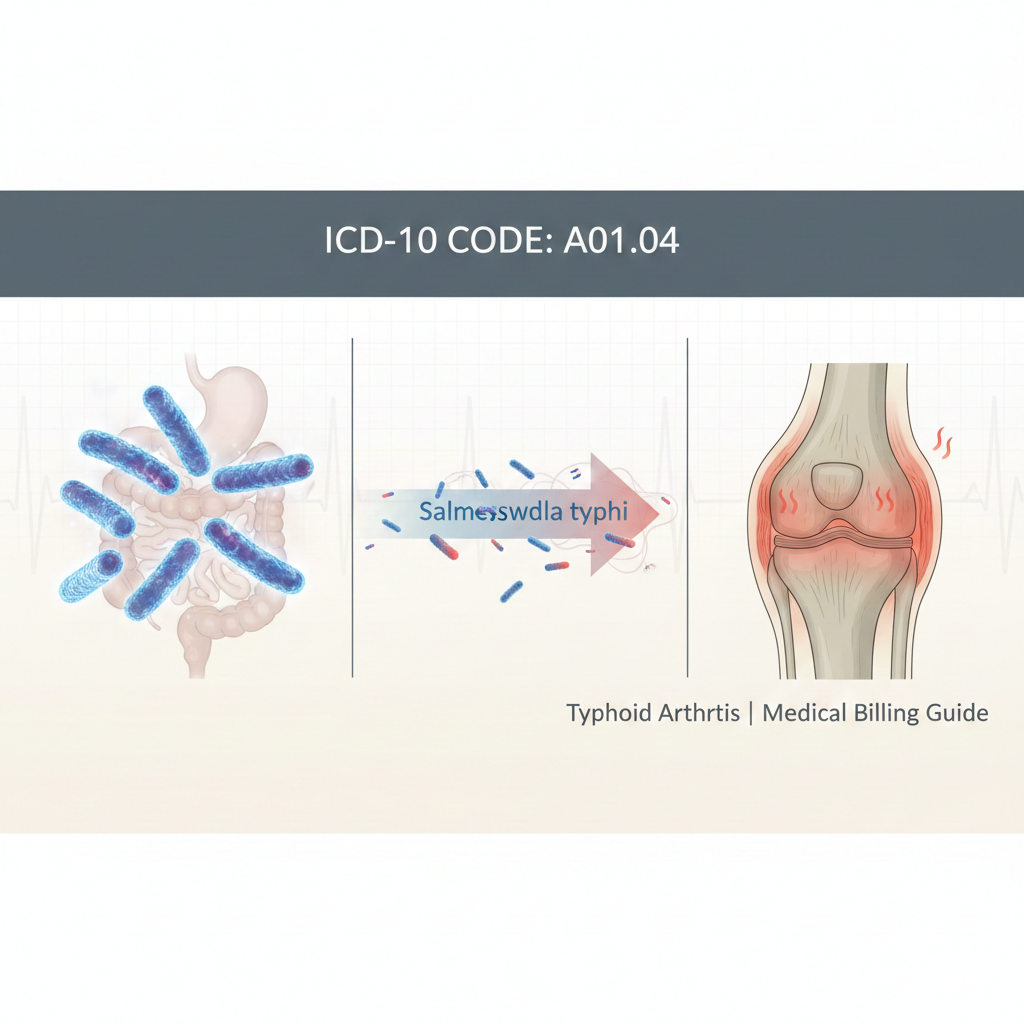
Typhoid arthritis is like a domino effect gone wrong. First, the Salmonella typhi bacteria set up camp in your gastrointestinal tract. Then, instead of staying put, these troublemakers decide to take a road trip through your bloodstream, eventually settling into your joints like squatters who refuse to leave.
Why Should Medical Billers Care?
Here’s the thing about A01.04: it’s about as common as a unicorn sighting in most developed countries. Research shows that joint complications from typhoid occur in only about 0.1 to 0.2% of septic arthritis cases in children. But when it does happen, accurate coding becomes crucial.
Getting this code right matters for several reasons:
Reimbursement Accuracy: Insurance companies need to understand the severity and complexity of the condition. Typhoid arthritis isn’t your run-of-the-mill joint infection. It requires specific antibiotic treatment, possibly surgical intervention, and longer recovery periods.
Patient Records: This code tells a complete story. It signals that the patient has both an infectious disease and a musculoskeletal complication, which affects treatment planning and follow-up care.
Public Health Tracking: In areas where typhoid remains endemic, tracking these complications helps health authorities understand disease patterns and allocate resources effectively.
Clinical Picture: What Doctors See
Imagine you’re treating a patient who came in a few weeks ago with high fever, abdominal pain, and maybe those telltale “rose spots” on their chest. The fever was climbing higher each day like a thermometer trying to break records. You diagnosed typhoid, started antibiotics, and things seemed to improve.
Then, boom. Two weeks later, they’re back. But this time, their knee is swollen like a balloon, painful to touch, and they’re limping around like they’ve aged 50 years overnight. The joint is warm, tender, and moving it feels like grinding rusty gears.
That’s typhoid arthritis in action. The bacteria that caused the initial typhoid fever have now invaded the joint space, turning it into an inflammatory battleground. The most commonly affected joints are the peripheral ones: knees, ankles, and elbows, basically the body’s major moving parts.
Documentation Tips for Accurate Coding
Getting A01.04 right requires solid documentation. Here’s what you need:
Your medical records should clearly indicate:
- Previous or concurrent diagnosis of typhoid fever (confirmed through blood culture, bone marrow culture, or serological tests like Typhidot)
- Clinical evidence of joint involvement (swelling, pain, limited range of motion, warmth)
- Laboratory findings showing elevated inflammatory markers
- Results from joint aspiration if performed
- Culture results confirming Salmonella typhi in synovial fluid
Without this documentation chain, you might end up with a denied claim faster than you can say “audit.”
Treatment Implications for Billing
The treatment for typhoid arthritis is like fighting a war on two fronts. You’ve got antibiotics targeting the bacterial infection (think ceftriaxone, azithromycin, or fluoroquinolones), plus management of the joint inflammation itself.
Some patients need arthrotomy and debridement, which means surgical cleaning of the infected joint. Others might respond to intra-articular steroid injections. Recovery can take weeks to months, which means multiple visits, procedures, and follow-ups. Each of these generates additional codes and claims.
The Global Context
While typhoid arthritis might seem like a relic from medical history textbooks in places like the United States, it’s very much alive and kicking in developing regions where sanitation infrastructure struggles to keep up with population growth. Countries in South Asia, Southeast Asia, and sub-Saharan Africa see the bulk of these cases.
For medical billers working with international patients, travelers returning from endemic areas, or in facilities that serve immigrant populations, A01.04 might appear more frequently than you’d expect.
Common Coding Mistakes to Avoid
Don’t confuse A01.04 with other arthritis codes. This isn’t rheumatoid arthritis (M05-M06), osteoarthritis (M15-M19), or even other infectious arthritis codes. The “A01” prefix specifically ties it to typhoid fever caused by Salmonella typhi.
Also, remember that if the patient has typhoid fever without joint complications, you’d use a different code from the A01 family. The “.04” extension is specifically for the arthritis complication.
Why Specificity Matters
In the world of ICD-10, specificity is king. The transition from ICD-9 to ICD-10 gave us thousands more codes for a reason: to capture the nuanced reality of medical diagnoses. A01.04 exemplifies this perfectly. It’s not just “typhoid” or just “arthritis.” It’s the precise intersection of both conditions.
This specificity helps researchers track disease patterns, helps public health officials identify outbreaks, and helps insurance companies understand resource utilization. It’s the difference between painting with a broad brush and using a fine-tipped pen.
Looking Forward
As our world becomes increasingly interconnected through travel and migration, codes like A01.04 remind us that “rare” diseases in one location might be common challenges elsewhere. For medical billers and coders, staying informed about these less common codes keeps you sharp and prepared.
Whether you’re working in a bustling urban hospital serving diverse populations or in a clinic in an endemic region, understanding A01.04 adds another tool to your coding toolkit. Because when that unusual case walks through the door, you’ll know exactly how to capture it accurately in the patient’s medical record and billing claim.
Remember, every code tells a story. A01.04’s story is about a bacterial infection that refused to stay in its lane, spreading from the gut to the joints and creating a complex medical situation that requires precise documentation and accurate billing. Getting it right means better reimbursement, clearer medical records, and ultimately, better patient care.