You know that feeling when you’re following a recipe, and everything’s going smoothly until you realize you need to substitute an ingredient? That’s kind of what happens when a doctor encounters typhoid fever with complications that don’t fit the typical boxes. Enter ICD-10 code A01.09 – the medical billing world’s way of saying, it’s typhoid, but with a twist.
What Exactly Is A01.09?
Let’s break this down like we’re explaining it to a friend over coffee. Typhoid fever is already a serious bacterial infection caused by Salmonella typhi. Think of it as an unwelcome guest that overstays its welcome in your body, causing high fever, weakness, stomach pain, and sometimes a characteristic rash.
But sometimes, typhoid doesn’t just follow the standard playbook. It decides to cause complications that are real and significant, yet don’t fall into the more specific categories that already have their own codes (like typhoid meningitis or typhoid heart complications, which have their own special codes).
That’s where A01.09 comes in. It’s like the “other” category on a survey form, except this one is clinically important and financially necessary for proper medical billing.
When Do We Use This Code?
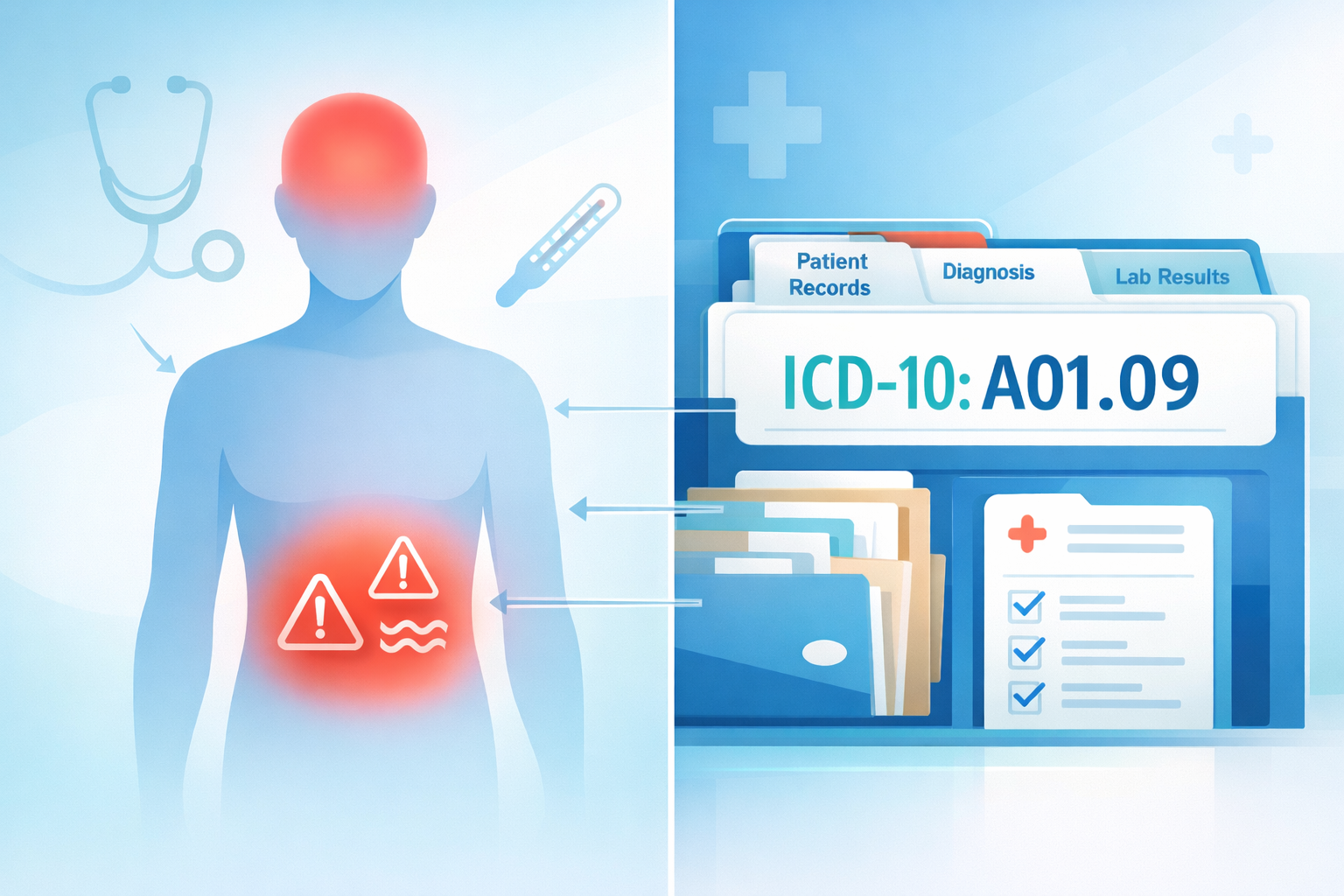
Picture a filing cabinet in a doctor’s office. The A01 category houses all the typhoid and paratyphoid fever codes. Within that drawer, you’ve got specific folders for specific complications. But A01.09? That’s the folder labeled “complications we need to document, but don’t have their own special folder.”
Medical coders reach for A01.09 when a patient has typhoid fever PLUS:
- Complications that are verified and documented
- Issues that don’t match the criteria for A01.01, A01.02, A01.03, or A01.04
- Problems directly related to the typhoid infection but not specifically listed elsewhere
Think of it as a safety net that catches important clinical situations that might otherwise fall through the cracks.
Why This Code Matters (More Than You Think)
Here’s where things get real for healthcare providers and billing departments. Using the right ICD-10 code isn’t just about paperwork – it’s like using the right address when sending a package. Get it wrong, and your claim might end up in the wrong place, rejected, or delayed.
For Healthcare Providers: This code tells the complete story of what’s happening with your patient. It’s not just “typhoid fever” – it’s “typhoid fever that caused additional problems we’re treating.”
For Medical Billers: A01.09 justifies more extensive treatment, longer hospital stays, additional medications, and specialized care. It’s the difference between getting reimbursed appropriately and leaving money (and accurate medical records) on the table.
For Insurance Companies: This code signals that this isn’t a straightforward case. It’s a heads-up that additional resources were medically necessary.
Real-World Scenario
Imagine a 35-year-old patient comes in with confirmed typhoid fever. Beyond the typical symptoms, they develop severe dehydration requiring IV therapy and electrolyte monitoring, plus some kidney function issues that need watching. These complications are real, documented, and require treatment, but they don’t fit into the more specific typhoid complication codes.
Boom – that’s your A01.09 moment.
The Documentation Dance
Here’s a pro tip from the trenches: this code is only as good as the documentation supporting it. Your physician needs to clearly document:
- The confirmed diagnosis of typhoid fever
- The specific complications present
- Why these complications are related to the typhoid infection
- The treatment plan for these complications
Think of documentation as building a bridge between clinical reality and billing reality. Without solid documentation, that bridge collapses, and your claim goes down with it.
Common Coding Mistakes to Avoid
Even experienced coders sometimes stumble. Here are the banana peels to watch out for:
- Using A01.09 as a default when a more specific code exists
- Forgetting to code the specific complications separately if they need their own codes
- Not verifying the complication is actually related to typhoid and not a coincidental condition
- Inadequate documentation to support the use of this code
The Bottom Line
ICD-10 code A01.09 might seem like a small piece of the medical coding puzzle, but it’s a critical one. It ensures that complex cases of typhoid fever are accurately represented in medical records and properly reimbursed by insurance companies.
For medical coders and billers working in infectious disease, internal medicine, or hospital settings, understanding when and how to use A01.09 can make the difference between a clean claim and a headache-inducing rejection.
Remember: good coding is like good storytelling. It needs to be accurate, complete, and paint the full picture of what’s happening with the patient. A01.09 helps you tell that story when typhoid fever decides to write an unexpected chapter.
Have questions about A01.09 or other typhoid-related ICD-10 codes? Drop a comment below, and let’s figure it out together!